Our tagged gray seal—Bronx—has been busy in the inshore and offshore waters around Cape Cod these past six months as he continues to carry our GPS tag that pings back location, dive, behavior, and oceanographic data. Over the 155 days (just over 5 months and counting) of successful relocation and data transmission, the mobile-enabled GPS tag, Bronx has covered nearly 40,000 km2, an area roughly the size of Massachussetts and Connecticut combined. Clearly, Bronx is a traveler unafraid of straying beyond the local neighborhood and environment.
In the past 5 months, the modern tagging technology we deployed in collaboration with others has confirmed some behaviors and activities we expected of seals in this area when we began the tagging project. However, the data has also revealed new discoveries about seal ecology, emphasizing the unique nature and adaptation of these seals as they recolonize their historical habitats in the US Northwest Atlantic. These findings are summarized here in the Map that shows different-scaled home ranges (i.e., where the animal can be found 25% of the time, 50% of the time, and so on) and discussed further in the post. Let’s explore these one by one.
1. Route 6 Commuter: Bronx’s Cape-wide distribution
Bronx is no stranger to any of the beaches or nearshore waters off the Route 6 roadside that transects Cape Cod, leaving few stretches of the coast unexplored. Even at a minimal home range where Bronx is found 25% of the time, Bronx exhibits a cape-wide distribution. Still every commuter has their favorite stretches of the road and Bronx is no different. He appears to split time between resting beaches (termed “haulouts”) at the north and south ends of Cape Cod. In the south, the animal appears to use Monomoy Island as home base, returning repeatedly and spending long resting periods here. Expectedly, Monomoy Island is a popular haulout and always seems brimming with abundant seals on the beach. In the north, activity centers around beaches near to North Truro, where the animal can travel up into Stellwagen Banks NMS and into Cape Cod bay easily.
2. International Traveler: Bronx visits Canada for “business” or “pleasure”?
Another exciting finding in the tag data from Bronx was two long-extended forays (see tracks highlighted on the map), including one across the Exclusive Economic Zone (EEZ) international boundary that divides Canadian waters from the U.S. waters. During this international journey, Bronx appears to navigate to Georges Bank and spend 12 days at the storied and historic fishing grounds. Spending nearly 2 weeks at sea, Bronx travelled 1300 km in total before returning to the southern end of Cape Cod. Our upcoming dive analysis will begin to evaluate Bronx’s activities on Georges Banks.
Since New Year’s however, Bronx has spent nearly all of his time journeying back and forth across the Great South Channel southeast of Cape Cod and Nantucket Island. In back-to-back-to-back- to-back- to-back trips (yep, that’s 5 return trips!), Bronx has explored these offshore habitats for over a month now. On each following trip, Bronx appears to travel farther across the channel and farther from the Cape. As of 13 February 2013, Bronx reported in from the northern tip of Nantucket near Coskata-Coatue Wildlife Refuge. Whether this is just another break from the offshore forays or a more permanent “stay-cation” in the nearshore waters of Cape Cod will have to wait for another blog post when the next chunk of data transmits.
Home range analysis of a Bronx shows a cape-wide distribution with haulouts at North Truro and Monomoy Island
3. Deep-water diver: Bronx goes deeper
In addition an exciting journey to Canadian waters and week-long visit at Georges Bank, Bronx has shown off its diving prowess in the past 5 months. Just before arriving at Georges Bank, Bronx dove to an impressive 265 meters deep on a dive that lasted 8 minutes (you try holding your breath for 8 minutes!). The research team is now trying to evaluate this extraordinarily deep dive and confirm it as one of the deepest (if not the deepest) dive observed yet in a wild gray seal. For comparison, Bronx’s average dive is around 40 meters deep lasting less than 3 minutes. Still, dives beyond 200 meters deep are not infrequent for Bronx, who has recorded 33 dives to these deeper habitats and even more between 100 and 200 meters. Seals dive for many reasons, including to travel, eat, or explore. The research team is now building models to analyze each of these dives in association with the movement and habitat to understand if the dive is an effort to find and feed on prey.
Summary
The tag Bronx carries on his back is expanding society’s knowledge about important habits, habitats, and adaptations of gray seals in Cape Cod. A robust gray seal population has not persisted here in the Gulf of Maine for decades and these animals are challenged to adapt their life history to the new marine environment. The research team eagerly awaits each new transmission from the tag to analyze it and compare it to what the research world already knows of gray seals. We can’t wait to report back when Bronx pings back the next bit of data.
We’ve been tracking Bronx – our Cape Cod iSeal – for about 37 days and we are starting to learn a little about this seals habits. This in turn, helps us understand a bit about his preferred habitats.
Bronx is splitting time between foraging trips at two haulout locations (red circles on image below) – one near the southeast tip of the outer Cape not far from Chatham, and the other off North Truro near a location called High Hill. Both are known grey seal haulouts and the northernmost is proximate to a location just offshore that Bronx seems to be spending a large amount of time foraging within (blue circle). The image below illustrates these two locations, and the nexus of tracks that criss-cross just offshore of North Truro. I wonder what seal-goodies are found out there?
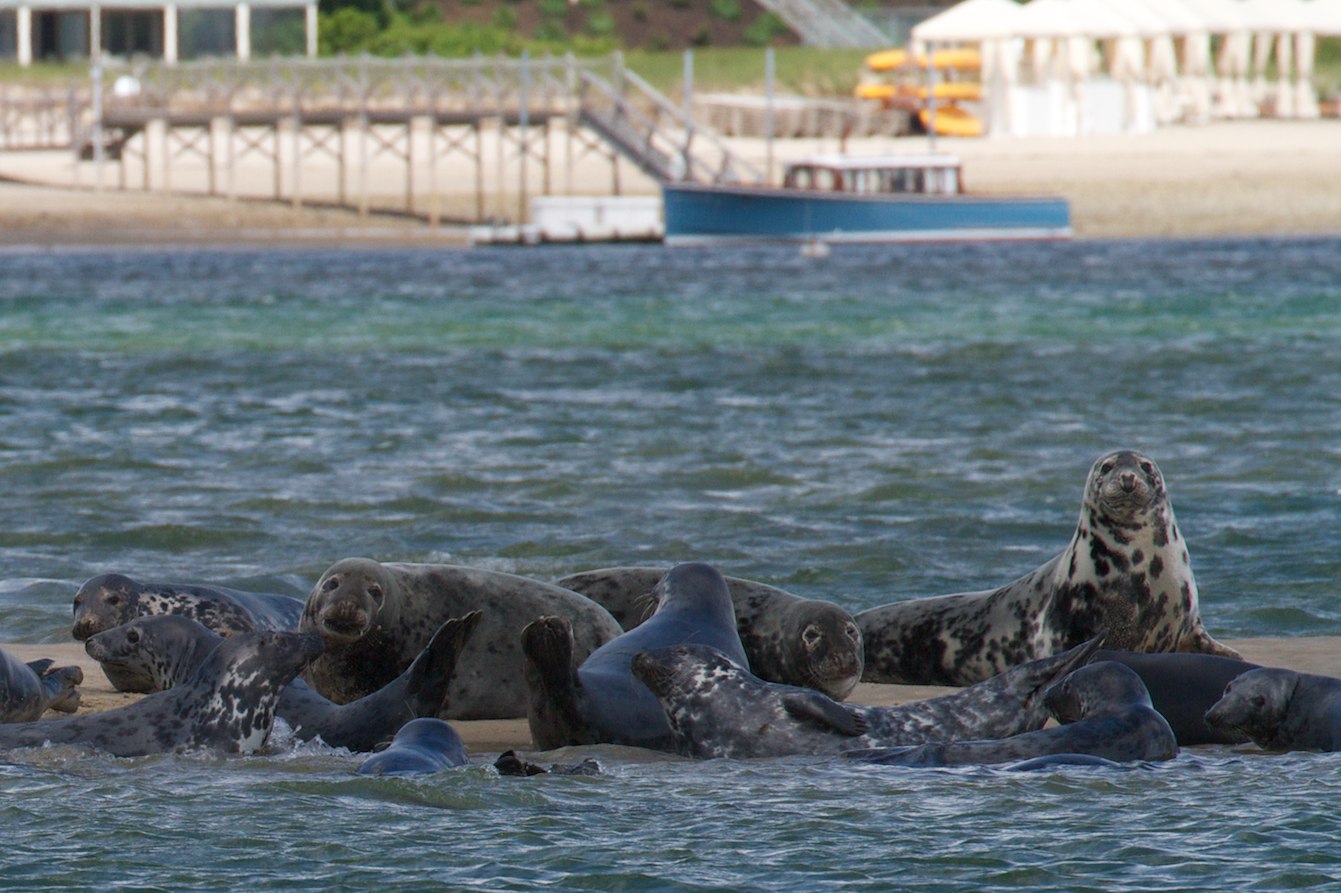
This must be a popular hangout for grey seals – check out the video below that gives a great perspective of the seals hauled out there. Bronx is now amongst them! Thanks to Mikołaj Zybała for the great grey seal muzzleshot as a lead in.
This last video is actually footage of the release of the animals – pretty cool to see him trundle off into the great blue. I think he is doing well, which is nice to see after being rehabbed! Both Videos curtesy of mkalbis on YouTube.
On September 15, 2012, a grey seal – named Bronx – was released from West Dennis Beach on Cape Cod with a tag on it’s back. After about 10 days cruising along the shores of Cape Cod, the seal hauled out between Chatham and Monomoy and delivered the first bundles of information about it’s movements and diving behavior back to us. Pretty cool stuff. I’m calling Bronx our ‘iSeal’ (hope Apple doesn’t mind…).
The animal had recovered from a fisheries interaction thanks to the rescue and rehabilitation efforts of folks at the International Fund for Animal Welfare (IFAW) and the Mystic Aquarium. After being nursed back to health the animal was fitted with a new type of telemetry device to assess it’s movements post release. This device, referred to as a ‘GSM tag’ (created by the smart people at Scotlands Sea Mammal Research Unit) combines a Fastloc Global Positioning System (GPS) receiver with a depth sensor and thermistor system to capture details on the seals movements, diving behavior and water temperature on foraging trips away form the beach. However, instead of relying on expensive satellite systems to relay these data back to us, the tag stores the data until the seal returns to the beach. When it does, the tag links into the local cellular phone system and transfers the data across this connection to computers ready to crunch the data. Thanks to Lisa Sette at the Provincetown Center for Coastal Studies (PCCS) for her heroic efforts in mapping out GSM coverage on Cape Cod – that was critical to ensure that we could execute the study successfully!
Anyone out there with an iPhone and the “Find My Friends” feature enabled can relate to this, and our ‘iSeal’ Bronx uses essentially the same technology to give us new insights into what seals do when they leave the beaches and disappear from view. The seal clearly doesn’t have pockets to put the tag in, so we had to attach it securely to the seal before he headed off. The attachment process is benign – the tag is simply glued onto the fur of the seal and the tag will be shed when the seal molts sometime in the next year or so. The tag was expertly fitted by Rob DiGiovanni from the Riverhead Foundation.
Bronx is the first ‘iSeal’ on the U.S. east coast, and this initial deployment is part of a larger collaborative project amongst Duke University, IFAW, PCCS and Riverhead that aims to assess the roles that grey seals play in the local marine ecosystem and how their movements overlap with fishing gear and effort. We also hope that these types of devices will help us understand the movements of seals around the Cape Cod region in relation to the growing number of white shark predators found there.
The images in this post provide some details on the data provided by the tag when the seal calls in over the network. The first image at right is the track of the seal over about 10 days. The animal made a series of movements north along the Cape, and then moved around the northern tip into the hook. After a short stint there it moved back offshore the northern end of the Cape and concentrated some foring effort in a localized region. Then is moved back inshore and along the beach south to Monomoy, to join a colony of grey seals for the past two days.
Bronx Temp Profiles Sept 22
The thermistor system on the tag provides us some cool glimpses of how water temperature that the seal encounters varies on dives. Temperature is a key variable for life in the ocean. It likely structures the availability of prey of these animals to some extent, and has implications for the thermoregulatory physiology of the seals themselves. The image at right shows temperature profiles obtain by the tag as the seal swam up to the surface on September 22nd. The vertical access labeled pressure gives details on the depth in meters and the horizontal axis provides water temperature values at that depth.
Using an archival tag coupled with high-bandwidth wireless communications gives us the ability to collect, store and transmit a lot of data. This means that the information on diving behavior of a tagged seal is not decimated and summarized into small amounts of information as done with satellite linked tags. In our case we get everything, the entire dive profile of the animal is sent back to us, providing a the complete story of the animals diving habits. Below is a KML of the movements of Bronx. Some of the tracks are close to shore or on it because the GPS doesn’t sample as frequently as the pressure sensor. But if you are good with Google Maps, you can zoom in on individual locations and really see what the seal was up to.
I want to end the post with a cool link into another GPS tagging project that links into this one nicely. Greg Skomal and his colleague Chris Fischer recently tagged a great white shark just off the beach in Chatham. There is a great story about this on the NY Times here. The image below is a screenshot from Chris Fisher’s tagging website that illustrates where Genie the white shark was tagged and where she has gotten to over the past few days. The red line in the center of the image illustrates that the shark was tagged directly offshore of the seal colony at Chatham and then moved south to Nantucket. This track really illustrates the interesting predator/prey relationships amongst the grey seals lounging on the sand beaches of Monomoy and the white sharks waiting offshore for a fresh seal meal.
White shark tagging and tracker
I’ve just returned from a quick trip to Provincetown, MA where I attended a seal/fishery interaction meeting hosted by the Provincetown Center for Coastal Studies. The meeting, sponsored by the WHOI Marine Mammal Center, brought together an diverse array of stakeholders interested in the growing gray seal populations in the Cape Cod region and elsewhere in the NW Atlantic. The meeting was a one day deal, with presentations in the morning and plenary discussion in the afternoon. I was really impressed by the people who attended. There were at least a dozen fishermen around the table, representing mobile and fixed gear fisheries, and I was especially impressed at the work being conducted by one of the wier fisherman. He has been working closely with PCCS scientists to study how grey seals interact with his weirs.
I was there to introduce a new project in our lab – the deployment of cell-phone tags on gray seals. These tags provide incredible detail on the movements of tagged animals, and are the perfect tool for beginning to study how seals use coastal and pelagic waters, and how their movements and foraging efforts may overlap in space and time with humans activities like fishing. This type of data is essential to any study of the ecological role of seals in the Gulf of Maine, and will provide a huge amount of information relevant to the study of operational interactions (by catch, depredation) between seals and fisheries in the local region. These tags are archival, but do not have to be recovered. Instead, when seals return to haul outs the tags call up the local cell network and essentially FTP the data off the tag to the researchers computer! We haven’t deployed any tags yet – but – when our seals call home, they may call home on America’s most reliable network <grin>.
The embedded video below provides an excellent example of the utility of these tags for studying the movements of pinnipeds. This movie illustrates the movements of a monk seal in the Main Hawaiian Islands as documented by one of these tags. Thanks to Charles Littnan for getting this stuff up on the web for people to see! Watch the video closely – you’ll see a yellow “worm” squiggling around the screen – that’s the path of the seal generated by the tag. Keep in mind, there is a whole whack of dive data associated with the track that is not displayed…